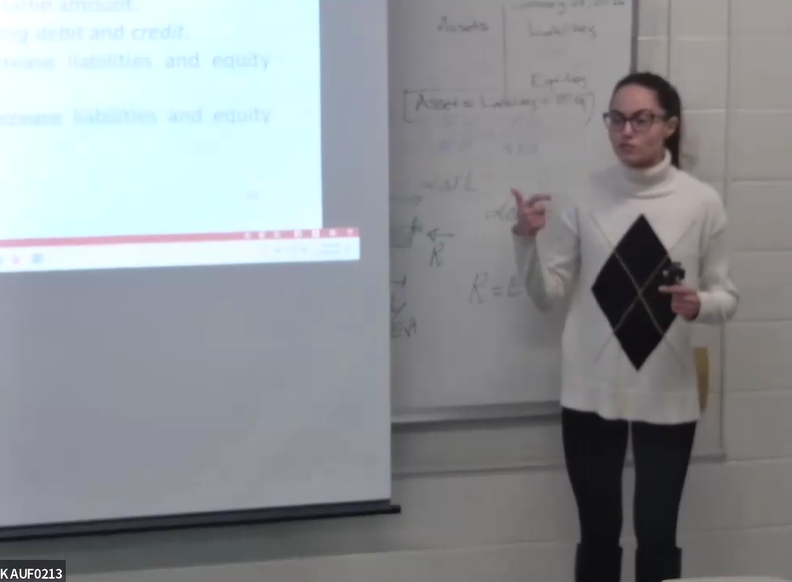
My teaching began during the final year of my Ph.D. and has since developed into an ongoing academic practice as an Adjunct Faculty member at Old Dominion University.
Statistical Concepts for Engineering Management (ENMA 420)
I teach a senior-standing/master’s-level course in probability and statistics for engineering management, designed to build both the theoretical understanding and practical problem-solving skills required for engineering analysis.
The course progresses from descriptive statistics and probability to probability distributions, estimation, and hypothesis testing, and then moves into applied methods including regression, statistical process control, and reliability analysis.
Rather than presenting statistics as a collection of formulas, I emphasize its role as a language for reasoning under uncertainty. Students apply statistical concepts to problems arising in engineering design, manufacturing, quality assurance, and reliability, learning not only how to calculate a result but also how to determine whether that result is meaningful for an engineering decision.
I also developed the online version of ENMA 420 in collaboration with ODU Global, contributing to course architecture, digital pedagogy, instructional materials, and the design of a high-quality asynchronous learning experience. This work expanded my teaching practice from traditional classroom instruction into the design of learning environments in which students can engage with quantitative engineering concepts independently while still receiving structured guidance.
Systems Architectures (ENMA 660)
My teaching also extends to Systems Architectures, offered in both online and in-person formats. The course introduces students to the systems architecture paradigm through multiple architectural frameworks and enterprise engineering perspectives.
The emphasis is deliberately hands-on. Students learn systems modeling using UML and SysML and apply architectural concepts to real-world engineering problems rather than treating modeling as a purely representational exercise.
The course asks students to think beyond individual components and consider how functions, structures, interfaces, stakeholders, requirements, and system-level objectives interact. Through modeling assignments and architecture projects, students develop the ability to move between different levels of abstraction and communicate complex system concepts in a disciplined way.
My responsibilities include syllabus design, interactive lectures in both delivery formats, modeling assignments, and mentoring student teams through architecture projects.
Engineering Managerial Economics (ENMA 302)
This course teaches students how to connect engineering decisions with their financial and economic consequences.
The course covers cost estimation, managerial accounting, key financial metrics, valuation, and the time value of money, progressing to discounted cash-flow analysis using Net Present Value (NPV), Internal Rate of Return (IRR), and payback methods. Students also use sensitivity and scenario analysis to examine how uncertainty in assumptions can change an engineering investment decision.
The curriculum extends to the economic evaluation of engineering alternatives under depreciation, income tax effects, inflation, and risk, as well as capital budgeting for individual projects, project portfolios, and public-sector investments through benefit–cost analysis.
A central emphasis of my teaching is defensible cash-flow modeling and lifecycle cost thinking. Students are expected not simply to calculate an economic metric, but to understand what the metric means, what assumptions produced it, and whether the resulting decision is economically defensible.
My responsibilities include syllabus design, lectures, case-based problem sets, and mentoring student teams on engineering project appraisals.
Teaching Across Scales
Together, these courses reflect the breadth of my teaching interests.
Economics teaches students to reason about value and consequences.
Statistics teaches them to reason about evidence and uncertainty.
Systems architecture teaches them to reason about structure, interactions, and complexity.
The underlying objective is the same: to help engineers become better thinkers before asking them to become better calculators.