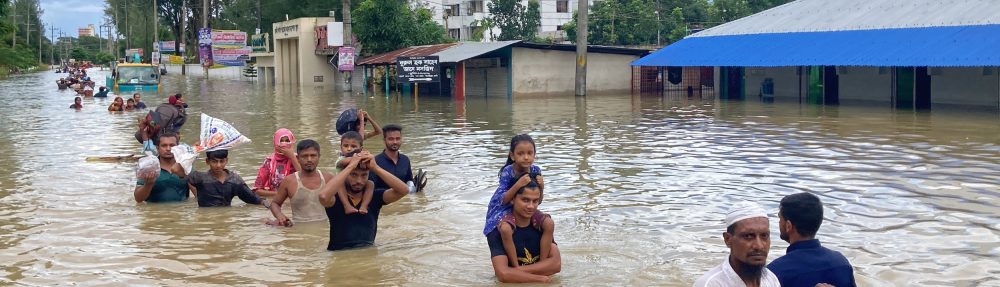
Our research focuses on adaptation to coastal hazards from local to national scales with an emphasis on interdisciplinary research on nature-based flood risk reduction. Our topics of interest include:
- Social vulnerability modeling,
- GeoAI analysis of natural hazards
- Theoretical framing of nature-based solutions,
- Interdisciplinary approaches to compound hazards risks,
- Equity in coastal flood risks, and related topics.
Recent and Ongoing Funded Projects
AI-Driven Spatial Targeting of Nature-based Solutions: A Prescriptive Framework for Compound Flood-Heat Resilience in Coastal Virginia
Funded By: ICAR CARMA (2026 – 27)
(Co-PI Maryam Golbazi)

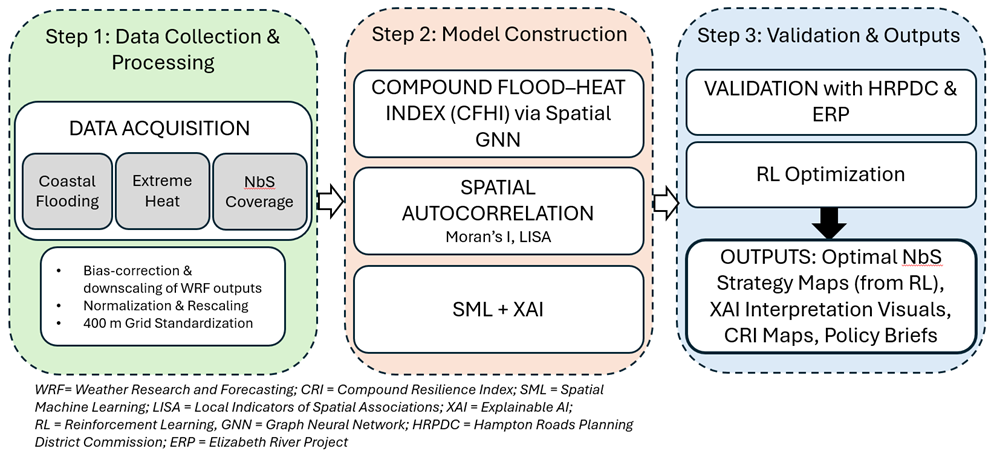
Coastal Virginia is increasingly threatened by compound climate hazards, where coastal flooding and extreme heat interact to create risks for air pollution, human health and ecological communities. This project will develop a spatially integrated framework, AI-enhanced framework to evaluate how Nature-based Solutions (NbS)—including wetlands, living shorelines, dunes, tree canopy, and conserved lands—mitigate overlapping flood and heat exposures across Hampton Roads. It evaluates how different NbS types coincide with or reduce compound flood-heat (CFH) hazards, identifying which NbS are most effective for heat or flood mitigation and under what spatial contexts.
Quantifying Building-Level Flood Recovery Benefits of Nature-Based Solutions: A GeoAI Scenario Analysis for Coastal Virginia
Funded By: ICAR RACP (2026 – 27)
(Co-PIs Lisa Wang, Marina Saitgalina)

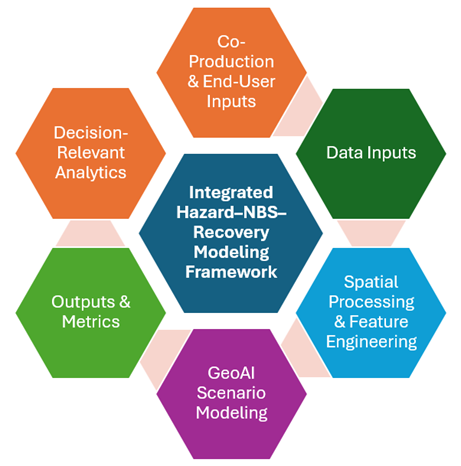
This project develops an Integrated Nature-based Flood Recovery Modeling (INFORM) framework to evaluate the spatial performance of NBS configurations by quantifying how the spatial configuration of NBS influences building-level flood recovery under future sea-level rise conditions (2050–2100). Recovery is modeled as a co-produced trajectory toward functional re-occupancy, integrating repair costs, probability of structural failure, and time-to-re-occupancy ranges and thresholds. The analysis evaluates how NBS density, type, proximity, and connectivity affect recovery outcomes and identifies configurations that produce the greatest reduction in recovery time per dollar invested relative to baseline conditions without NBS.