
Project Overview
This project will reshape the future of public safety by operating an artificial intelligence-powered drone as first responder program with onboard high-performance computing beyond the visual line of sight, eliminating the need for both human visual observers and ground-based surveillance systems.
Research Objectives
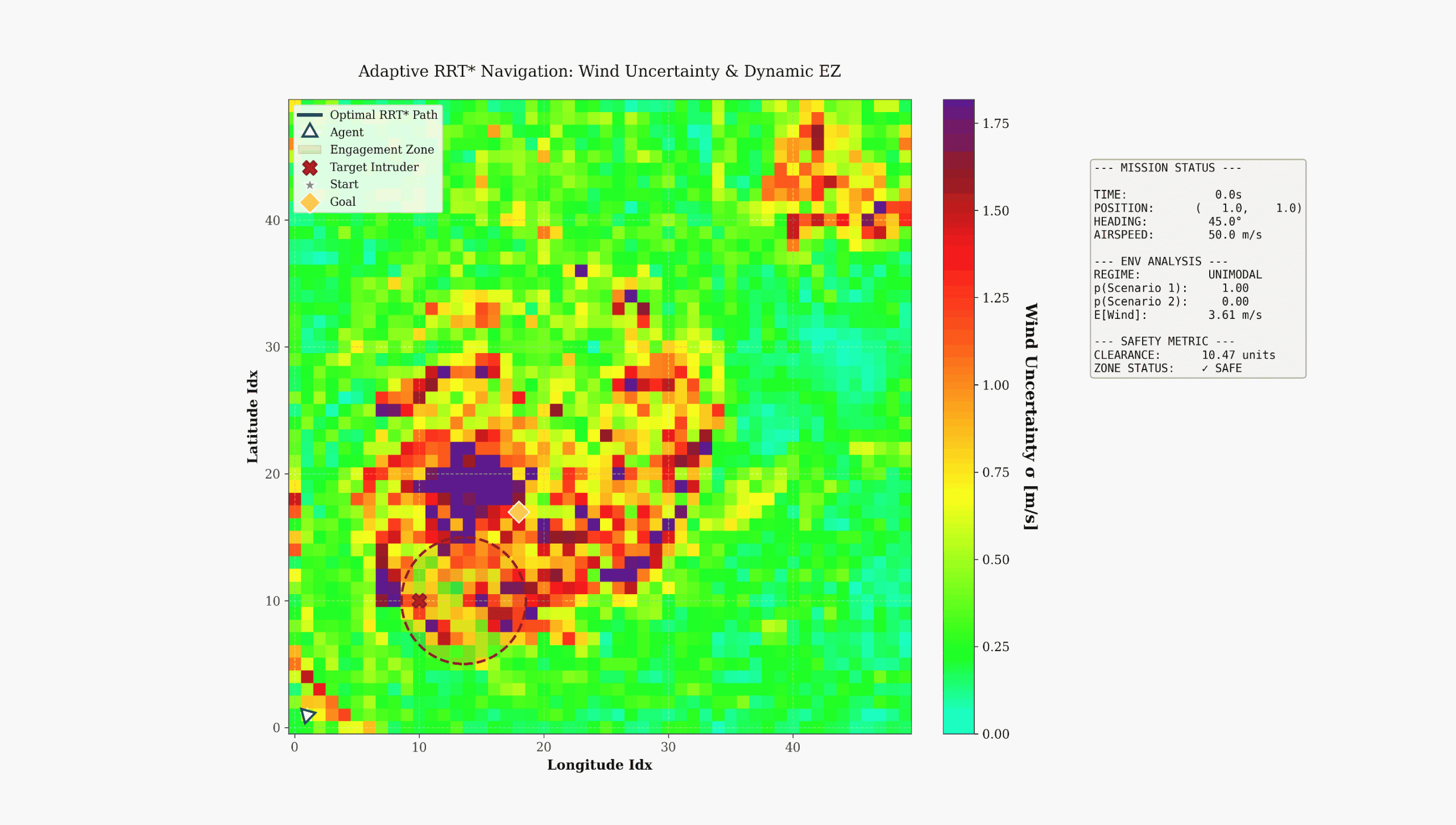
The project will enable a true drone as a first responder (DFR) to fly beyond the visual line of sight (BVLOS) under a high degree of onboard autonomy during adverse conditions through cutting-edge Artificial Intelligence (AI). To achieve this, a portable, scalable, and affordable computer vision Detect-and-Avoid (DAA) system will be integrated with a novel DFR intelligence independent of the other expensive manned and unmanned ground-based surveillance systems. Onboard agile and adaptive AI (AAAI) and Electro-Optical/Infrared sensing technologies can reliably detect, identify, and track targets in long ranges, including non-cooperative unmanned aerial vehicles under different speeds with/without Automatic Dependent Surveillance-Broadcast (ADS-B). A standalone prototype DFR will be validated in various scenarios, including simulated and laboratory environments. Hampton Roads and Virginia can obtain the first-of-its-kind waiver enabling BVLOS operations and meeting public safety needs. This project will accomplish three milestones by integrating sensors (Iris Automation or Trillium Engineering) into drones from the ground up with CCF funding for student A’s stipend and faculty times. ODU will match student B’s stipend, full tuition, and faculty times. Regular monthly meetings (e.g., Norfolk PD 15 minutes from ODU) will allow collaborators to provide input and validate the design of the scenarios compatible with the mobile command center. Collaborators will continue to meet through local conferences (e.g., Droneresponders, AUVSI). The testing will strictly follow the FAA guidelines granting the BVLOS waiver. Several benchmarks will include one of the potential sensors (Iris’s CASIA ground) already being tested in real-world scenarios (e.g., detection rate, failure to avoid, etc.). Instead of ground-based surveillance, which can only alert the drone to move to the safe zone and give up the original mission, we will show the benefit of the proposed onboard intelligence to help DFR continue to navigate to the destination while avoiding a collision. Innovative solutions will address three project risks to ensure public safety: 1) Spotty communication between DFR and the command center operator will be addressed by working with Verizon for their extension of low latency, providing a live inspection video feed to the operator; 2) Energy-aware AAAI will help DFR fly longer and return safely during adverse weather in coastal cities while exploring the potential for the water-proof design of drones. Nighttime capability is ongoing research by sensor vendors, which will be improved by this project; 3) We still have humans involved in deciding whether to deploy or not to a borderline priority case and where to deploy when concurrent deployment is required under limited resources. AAAI will provide simulation-based measurable utilities associated with each flight scenario before deployment, and the utilities will adapt to changes in the environment during the deployment.