
Short course (3 hours) designed to cover the basics of forced migration, host communities, and durables solutions.
Part 1: Flight
How many people are forcibly displaced?
Over 82 million people in the world are forcibly displaced. In the early years after the 1951 Refugee Convention, only refugees were tracked. But sine that time, the categories have expanded. Despite the fact that refugees are prominent in the global news media, actually most displaced people are internal to their home countries — they have yet to flee over a border.
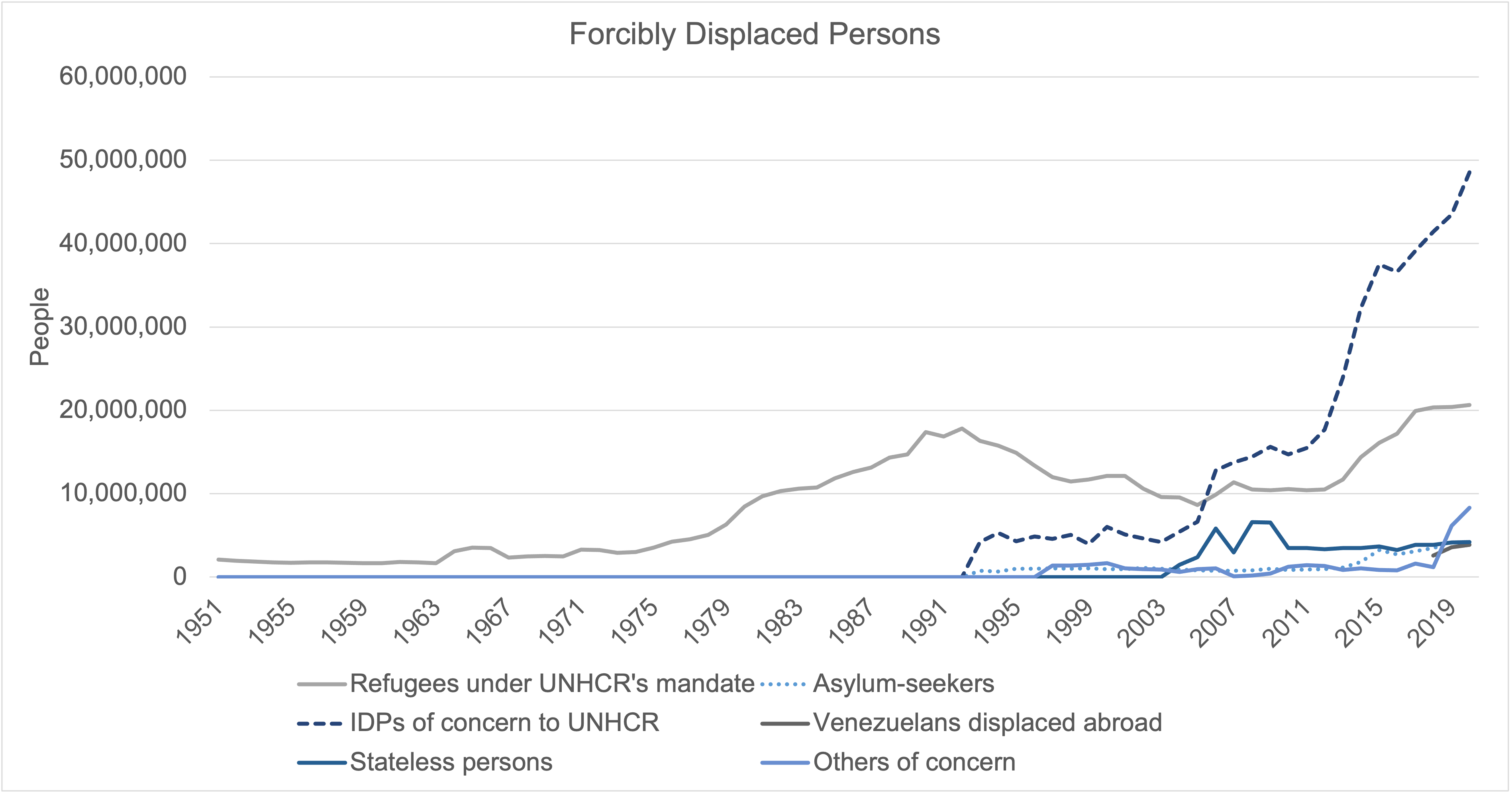
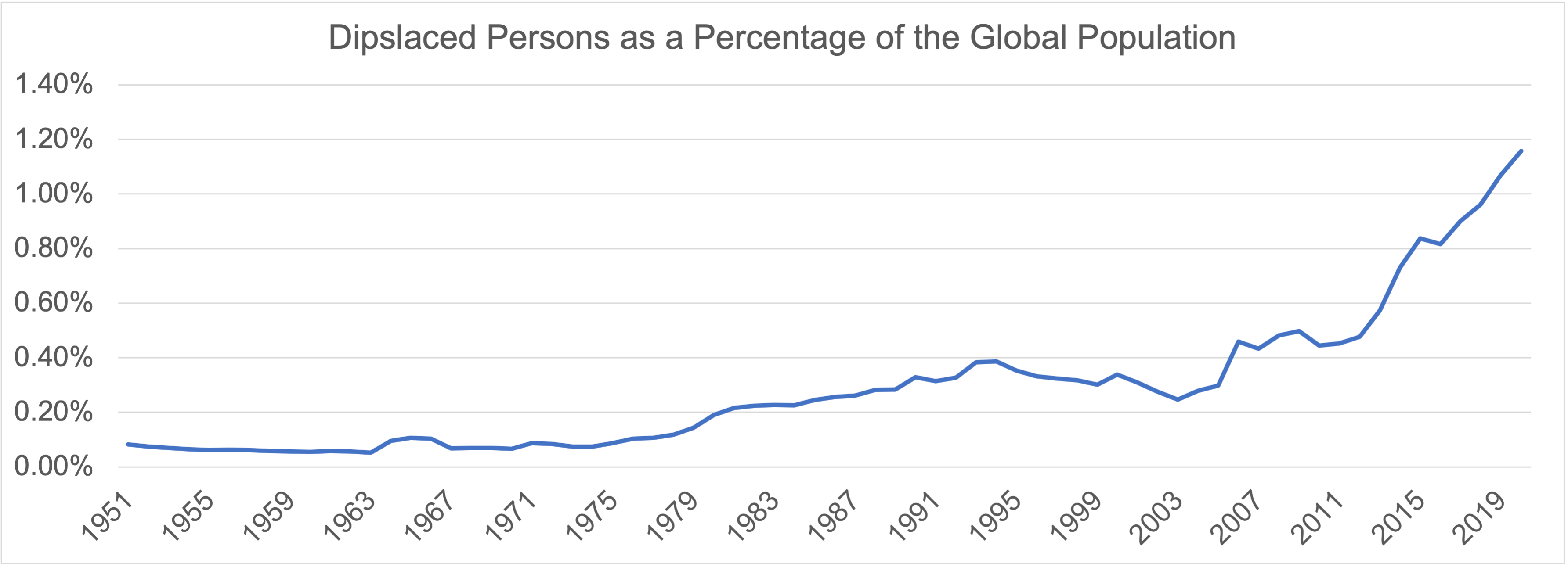
You can see above that the numbers have been increasing over time. But so has the global population. When we look at the percentage of the global population that has been displaced over time, you can see that the number is rising exponentially in recent times. These numbers really are unprecedented in history.
This picture is even more complicated–if you take what you see on the news at face value–because even though the numbers are higher, the vast majority of displacement is contained in the developing world. The United Nations Refugee Agency (UNHCR) provides some visuals about where refugee flee and what the general demographics of the displaced look like.
Who is a forced migrant?
There are different definitions that account for different situations. Refugees are probably the most commonly known through media and other public information sites, but other people who are forcibly displaced or otherwise vulnerable include asylum-seekers, stateless persons, and Internally Displaced Persons (IDPs). The United Nations Refugee Agency has a list of definitions related to these types of displacements and other common words associated with forced migration response.
Refugees and asylum-seekers in particular are internationally protected by the 1951 Convention Relating to the Status of Refugees, and the later 1967 Protocol. You can see the signatories of those two international agreements here. The 1951 Convention lays out who a “refugee” is by international standards, and what basic protections the signatories guarantee. Many of these protections are not provided in practice, such as the rights to work, education, and freedom of movement. The 1967 Protocol expands the definition of refugees to encompass more than just those displaced by World War II. 142 countries are signatories in some form on both of these protocols. Less universally accepted are the UN conventions related to statelessness and the reduction of statelessness. Fewer than 100 countries are signatories on these agreements for providing avenues to access nationality for stateless persons. The UN provides a summary of all treaties where you can see which countries have signed on to which international agreements and the original text of those documents.
But what influences the decision to flee can be more complicated than just the presence of violence or political persecution. Many factors contribute to the decision to leave one’s home. Someone can flee for both economic and political or environmental reasons. The Mixed Migration Centre has regionally-based surveys that begin to capture the complicated decision criteria that people assess when they migrate, as well as conditions such as reliance on smugglers that influence their journeys. The Mixed Migration Center has an interactive dashboard where you can look at different interview data by nationality or location of interview. This can give you an idea of what types of decisions, situations, and demographics characterize different migration pathways.
Other data portals, most by the United Nations, provide quick tools to assess the flows and demographics of certain contexts and get a centralized place to see updated reports about humanitarian situations on the ground. The UN Office for the Coordination of Humanitarian Affairs (UNOCHA) has a centralized location for collecting data and reports about country contexts and humanitarian response. UNHCR has a situations portal that provides data and country situation reports for urgent or large forced migration situations globally. And the UNHCR’s Refworld is an archive of country reports by the UN and partner organizations, as well as official government laws and policy documents related to forced migration. These can quickly be filtered by country and year.
When thinking about who forced migrants are, and the complicated decisions that go into uprooting, it’s also important to think about who they are not — at least from a globally recognized perspective. Climate change and environmental degradation are and important motivator for uprooting lives, and yet this is not a status recognized for international protections. UNHCR recently developed a disaster displacement visualization to illustrate the scope of climate migration and what’s at stake in terms of multiple, compounding risks to food security, conflict, and other drivers of forced migration. The Internal Displacement Monitoring Centre tracks climate and environmental migration, showing the devastating (and often invisible to many of us) impacts these natural hazards are having on people’s displacement globally. According to IDMC, 55 millions were internally displaced in 2020, but 318 million people have been newly displaced by disaster in the past 12 years.
Gender in Forced Migration
Women and children face additional burdens, violence, and exploitations in an already perilous forced migration journey. A UNHCR reports accounts of women’s experiences from across the world, highlighting the unique situations that women face along the way. These include traveling alone with children, sexual exploitation, assault, rape, and violence against their children. The UNHCR found that, when looking through a gender equity lens, 60% of preventable maternal deaths occurred among forcibly displaced women; that women and girls carry a disproportionate burden of caregiving tasks, many becoming the head of household; and that gender impacts access to care, as well as prevention efforts to cope with future crises.
When considering the impacts of COVID-19 on the global population, refugee women and children carried an even larger burden. All humanitarian and care services were impacted, but access to schools and protections against gender-based violence were disproportionately impacting forced migrants. UNHCR produced a visualization that summarizes different aspects of COVID-19’s impact on women and children.
Link to the workshop Part 1 slides: https://www.slideshare.net/secret/vNTdCCJn9m9fhn